
Stone Guest
Along the northern edge of the City of Mirrors, where mountains descend steeply toward dark, still waters, people have long believed that the stone remembers what humans forget. In villages clinging to cliffs and in noble houses built of cold rock, stories were quietly transmitted from mouth to mouth; warnings couched in the form of legends. Among the most awe-inspiring of these legends was the tale of the “Stone Guest.” This was not a story to be told lightly, nor to the children while playing, but to be whispered by the fireplaces and after the funerals, when the bells were still ringing in the hills. It was about a nobleman from the city whose pride surpassed the mountains themselves, and whose fall was as final as a stone. The arrogant nobleman
Noble Bashir lived in a stately house overlooking the lake, its balconies carved in pale stone and its halls decorated with statues brought from distant cities. He was wealthy, educated, and influential, accustomed to obedience and praise. The servants feared him, and the neighbors avoided crossing his path. He laughed at sermons and mocked funeral rituals, describing them as tools of fear for peasants. He boasted that death had no power over him, and that the stone was nothing more than an ornament. When an elderly Nabil died, Bashir attended not out of respect, but out of curiosity. The tomb was freshly finished, adorned with a meticulously carved statue of the deceased, his hands folded and his eyes raised in eternal prayer. Bashir stood before him and laughed loudly: “The stone does not hear.. and the stone does not rule.” In a moment of reckless ridicule, he struck the statue's foot with his stick and uttered words that sealed his fate: “If you are more than just a carved rock, come and have dinner with me tomorrow.” Those around him took refuge, and no one laughed with him. Accepting the invitation
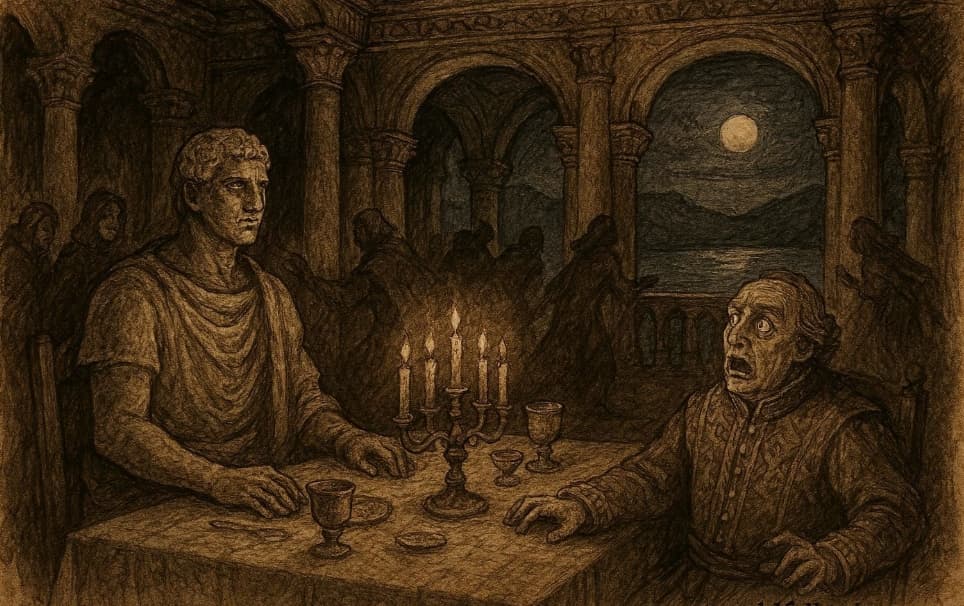
The next evening, the nobleman held a sumptuous banquet. The candles were burning and the tables were full of food. The music echoed in the hall as guests nervously ate their dinner, worried about the memory of that joking invitation. Then, as the last dish was being served, a sound echoed in the house. Heavy, slow, and unmistakable. Steps. The doors opened without being touched by a hand, and cold air swept through the hall. There stood the statue, no longer bound to the tomb, but erect, gray, without the color of life, but moving with a terrifying aim. His stone eyes turned toward the nobleman. the stone guest said, And his voice grinding like a rock hitting a rock: "You called me, you came." The guests fled in terror, the candles went out, and Bashir remained alone, pale but still pretending to defy. The account
The statue sat at the table, touching no food or drink. His presence froze the room, and the nobleman's courage faded for the first time. The stone guest spoke, not with anger, but with judgment. The number of the noble's sins: his cruelty to servants, his underestimation of the dead, and his pride in believing that he is above the consequences. “You laughed at what you didn't understand,” the statue said, “and thought silence was a weakness.” The nobleman tried to speak, but his voice betrayed him. The stone guest got up and held out a stone hand: “Now, you will answer.” When the nobleman touched the hand, he was seized by a cold that did not resemble any earthly cold. By morning, a lifeless corpse was found, his face frozen in terror. He had no wounds, and the illness did not explain his death. and the statue.. it was gone. The remaining warning
The house of the nobleman Bashir remained empty for years. Some claimed to hear footsteps echoing in its halls, others swore that on certain nights, a stone shape reflected in the lake's black surface could be seen. The people of the city of mirrors have learned that arrogance calls for calculation. Since that day, no one has mocked a grave. No one spoke disparagingly of the stone.